ATSC vs. QAM for HDMI RF Modulators
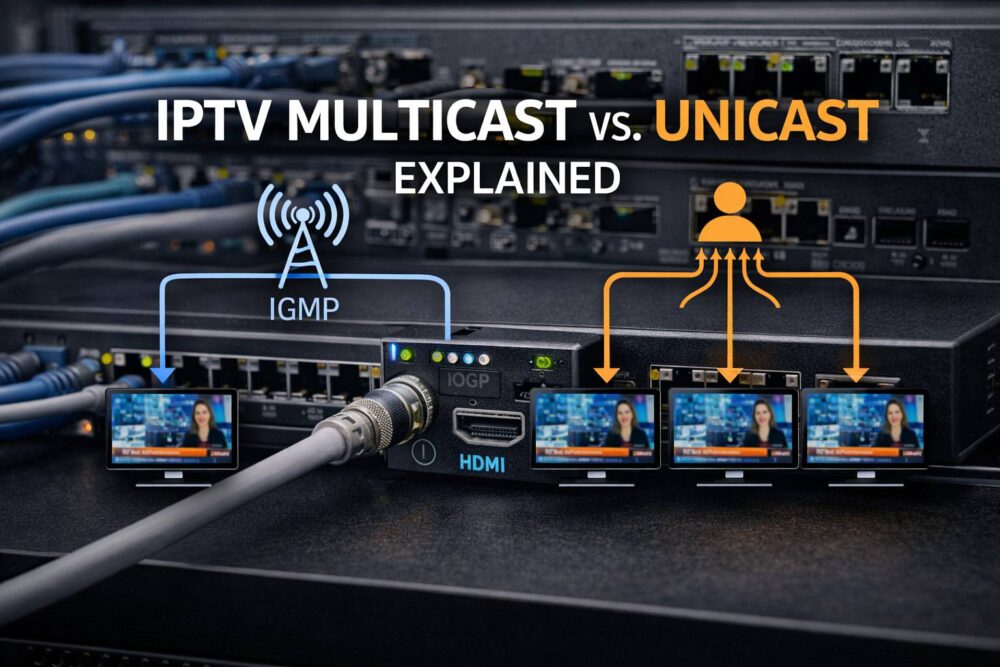
If you’re distributing an HDMI source over coax-hotel TV, campus channel lineup, sports bar “house channel,” digital signage, training feeds-the HDMI RF modulator is still one of the simplest ways to put video on every screen: HDMI in, RF channel out.
But in North America, you quickly hit the big fork in the road:
– ATSC (broadcast-style digital TV)
– QAM (cable-style digital TV)
Both can deliver excellent HD quality. The difference is compatibility, channel planning, and how your TVs behave in the real world. Here’s how to choose the standard that actually fits your coax plant and endpoints.
If you’re distributing an HDMI source over coax-hotel TV, campus channel lineup, sports bar “house channel,” digital signage, training feeds-the HDMI RF modulator is still one of the simplest ways to put video on every screen: HDMI in, RF channel out.
But in North America, you quickly hit the big fork in the road:
-
ATSC (broadcast-style digital TV)
-
QAM (cable-style digital TV)
Both can deliver excellent HD quality. The difference is compatibility, channel planning, and how your TVs behave in the real world. Here’s how to choose the standard that actually fits your coax plant and endpoints.
First: What your modulator really creates
An HDMI RF modulator does two jobs:
-
Encodes HDMI to a compressed digital stream (typically H.264 video + AAC audio, inside an MPEG Transport Stream).
-
Modulates that stream onto an RF carrier using a digital TV standard-ATSC or QAM-so the TV can tune it like a normal channel.
So this isn’t “analog Channel 3/4” nostalgia. It’s modern digital TV over coax, just generated locally.
ATSC in a nutshell (U.S. broadcast DNA)
ATSC 1.0 is the digital over-the-air TV standard used across the U.S. It’s designed for terrestrial broadcast, where signals need to survive reflections and variable reception conditions.
What that means for you:
-
Many TVs in the U.S. are guaranteed to have an ATSC tuner.
-
Channel scanning behavior often feels “OTA-like.”
-
Signal robustness can be good in challenging RF environments (though your coax plant is usually more controlled than OTA air).
Where ATSC modulators shine:
-
You want something that behaves like local “antenna TV.”
-
You’re deploying to displays where ATSC support is very likely and consistent.
-
You prefer OTA channel numbering conventions and scanning behavior.
QAM in a nutshell (private cable / hospitality workhorse)
QAM (typically 64-QAM or 256-QAM) is the modulation used by cable systems. In private coax plants-hotels, campuses, MDUs-QAM has been the go-to for years because it fits naturally into “internal cable TV” lineups.
What that means for you:
-
Many commercial/hospitality TVs support Clear QAM (unencrypted QAM).
-
If your building already has a “cable-style” headend, QAM usually integrates more seamlessly.
-
You can often pack lineups efficiently, especially when you’re combining many channels.
Where QAM modulators shine:
-
You’re building or expanding a private cable system.
-
You’re using hospitality-grade TVs known to tune Clear QAM reliably.
-
You need a cable-like channel map and operational workflow.
The real deciding factor: the TVs (not the modulator)
Here’s the uncomfortable truth: TV tuner behavior is the #1 success factor, and it varies wildly by model, market segment, and firmware.
Consumer TVs
-
ATSC support is a safe assumption in the U.S.
-
QAM support is increasingly inconsistent on some consumer models. Some still tune Clear QAM fine; others hide it, bury it, or implement it poorly.
-
Channel scanning can be unpredictable if the TV “expects” a cable provider lineup.
Hospitality / commercial TVs
-
Often tuned for headend environments and may have better Clear QAM support, channel locking, and management features.
-
Some properties standardize TV models specifically so QAM works consistently.
Practical takeaway:
If you don’t control the TV models-or you’re dealing with mixed brands-ATSC is often the safer default in U.S. deployments. If you do control the TV fleet (especially hospitality TVs) and want an internal cable lineup, QAM can be excellent.
Channel lineup integration: what else is on the coax?
Your coax plant might carry:
-
OTA off-air channels (via an antenna + combiner)
-
a satellite/cable headend
-
other modulators
-
legacy analog (rare, but it happens)
-
in-house channels you add
This matters because ATSC and QAM occupy RF spectrum differently in practice (and your TVs may scan them differently).
If you’re combining with off-air antenna channels
-
ATSC can feel “native” alongside OTA signals.
-
QAM can still work, but scanning and channel organization can be less intuitive on some TVs.
If you’re combining with an existing cable/QAM headend
-
QAM usually plugs into the same mental model: cable channels, cable scanning, cable-like frequency planning.
-
ATSC can still be combined, but the workflow becomes mixed-standard.
RF performance and plant tolerance
Both can look great-assuming your coax plant is healthy. The bigger issues are the usual RF basics:
-
Signal level too hot or too weak at the TV
-
Poor connectors, corrosion, bad splitters
-
Long runs without proper amplification
-
Ingress/noise
That said, ATSC was designed for over-the-air multipath challenges, while QAM assumes a more controlled cable environment. In most in-building coax plants, either can be stable if levels are set correctly-but if your plant is “marginal,” expect more troubleshooting regardless of standard.
Latency and picture quality: mostly not about ATSC vs QAM
With modern modulators, picture quality is driven mainly by:
-
codec (H.264/H.265)
-
bitrate (e.g., 4–12 Mbps per HD channel depending on content)
-
encoder settings (GOP/keyframe interval)
-
source quality
Latency is mostly influenced by encoding/decoding and buffering in the TV-not the modulation standard. In other words: don’t pick ATSC because you think it’s “faster.” Pick it for compatibility/workflow.
A simple decision framework
Choose ATSC if…
-
You’re in the U.S. and need maximum TV compatibility across mixed consumer displays.
-
You want the channel experience to resemble over-the-air TV.
-
You’re distributing to spaces where you can’t guarantee Clear QAM tuning (mixed TVs, BYOD displays, unknown firmware behavior).
-
You want a “set it and forget it” approach with fewer surprises during channel scanning.
Choose QAM if…
-
You’re building a private cable/hospitality lineup and you control the TVs.
-
You have commercial/hospitality displays known to handle Clear QAM well.
-
You’re integrating into an existing QAM headend workflow and want consistent channel mapping.
-
Your integrator/network of properties already standardizes QAM across sites.
Consider hybrid (yes, it’s common)
Some larger properties use:
-
QAM for the main in-house lineup on managed hospitality TVs
-
ATSC for compatibility zones or mixed-display areas
Or they go IPTV for many endpoints and keep RF for legacy TVs.
Quick “avoid pain” checklist before you buy hardware
-
Inventory your TVs (actual models).
Don’t assume “all TVs support QAM.” Test at least one of each model. -
Decide how users will scan channels.
Cable scan vs antenna scan vs locked channel maps-this changes everything operationally. -
Plan RF channels and frequency spacing.
Pick RF channels that won’t collide with existing services. Document it. -
Confirm codec/audio support.
If the modulator encodes H.265 but the TVs decode only H.264, you’ll have a bad day. -
Watch for HDCP on HDMI sources.
Many protected HDMI outputs won’t pass through professional modulation workflows. -
Measure signal levels at the farthest TVs.
Don’t guess. Coax plants fail quietly until they don’t.
Bottom line
For HDMI RF modulators in North America, the best standard is the one your TVs tune reliably and your plant can support consistently.
-
ATSC is often the safest bet for broad compatibility in the U.S., especially with mixed consumer TVs.
-
QAM is a strong choice for hospitality/private cable environments where TV models are controlled and Clear QAM tuning is proven.
For more information, please read the Hotel HDMI-to-QAM TV Distribution case study from Thor Broadcast.